Designing a More Natural AI Interaction
Client
Emma AI
Year
2026
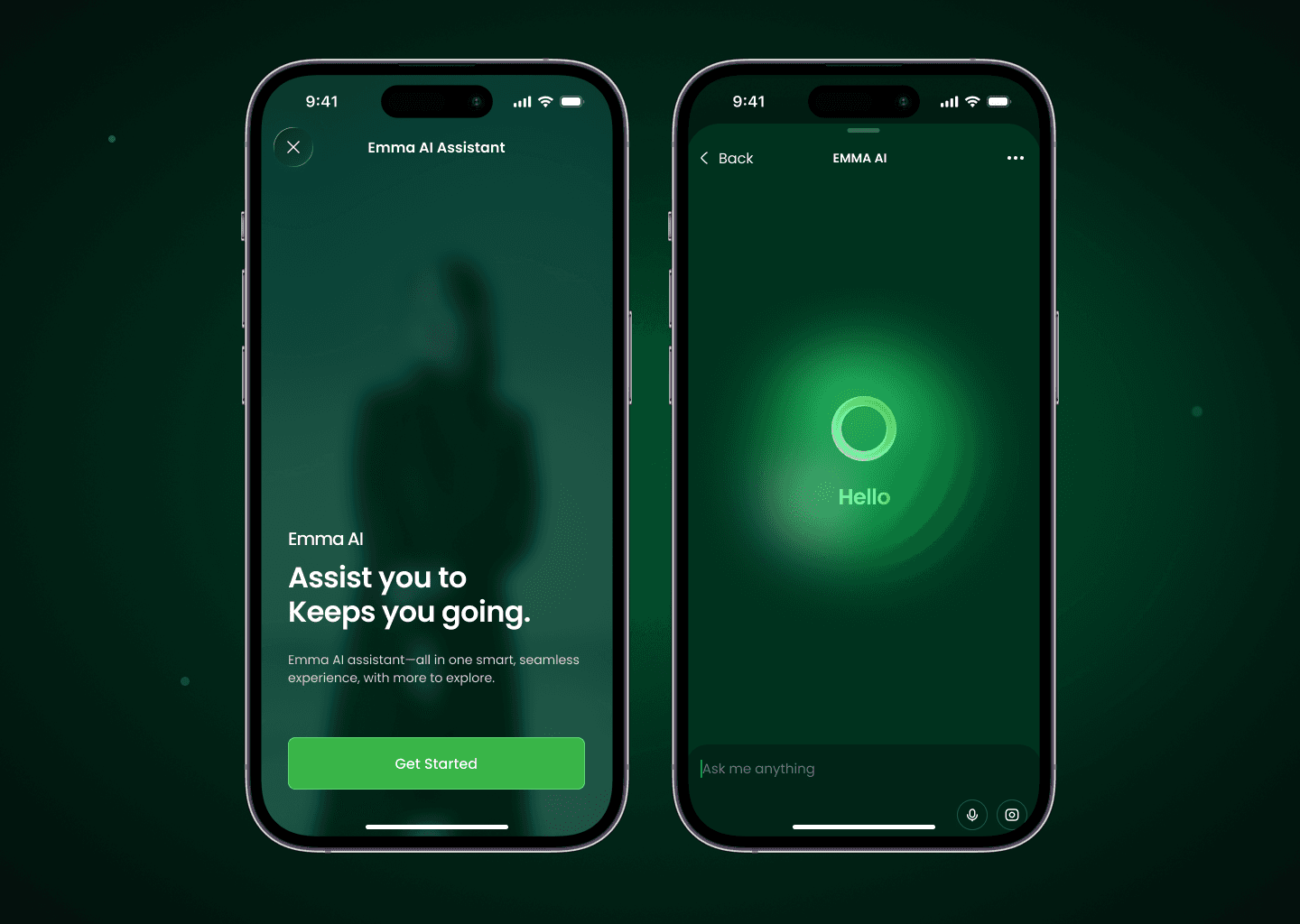
Overview
Emma AI is a conceptual mobile AI experience exploring how intelligent interactions can feel more natural, contextual, and visually expressive. The experience is built around a contextual AI entry point that transitions into an immersive assistant interface, using motion, spatial transitions, and a central visual AI element to create a continuous connection between the user and the AI. The project explores how interaction design and motion can make AI feel less like a separate tool and more like a natural part of the product experience.
Context
Product Concept
A mobile AI assistant designed around contextual interaction and conversational experiences.
Experience
An AI interaction that moves from a lightweight entry point into a focused assistant environment.
Problem Being Solved
AI experiences can often feel disconnected from the product they live within. Separate screens, static interfaces, and abrupt transitions can create unnecessary friction. The challenge was to create an AI interaction that feels immediate, continuous, and visually intuitive while keeping the interface focused on the conversation.
Business Challenge
Making AI feel approachable without oversimplifying the experience
Introducing AI without disrupting the user's existing context
Creating a clear and intuitive entry point into the assistant
Using motion to communicate interaction and system presence
Building a distinctive visual language for the AI experience
Balancing expressive motion with a minimal interface
UX Strategy
1 – Contextual Interaction
Creating a focused entry point that introduces the AI before activation
Keeping the interaction connected to the user's current context
Reducing the distance between discovering and engaging with the assistant
Using progressive interaction rather than immediately presenting a full AI interface
2 – Seamless Transitions
Designing the transition between the initial state and AI environment as one continuous interaction
Using movement and scale to preserve spatial relationships
Avoiding abrupt navigation between interface states
Creating a sense of continuity throughout the experience
3 – AI Presence
Using a central luminous AI element as the visual representation of Emma
Creating a recognizable visual anchor for the assistant
Using subtle movement and visual feedback to communicate presence
Exploring how an AI can have a visual identity beyond a conventional chatbot interface
4 – Motion-Led Experience
Using animation as part of the interaction rather than decorative movement
Designing motion to communicate state and responsiveness
Establishing transitions that reinforce the relationship between interface states
Creating a motion language that feels expressive while remaining minimal
Experience Layer
Focused AI entry point introducing the assistant
Contextual activation leading into the AI experience
Immersive conversational environment
Central AI visual creating a persistent point of focus
Connected transitions between interaction states
System Thinking
Consistent interaction principles across AI states
Reusable transition and motion behaviors
Clear relationship between visual hierarchy and interaction
Structured approach to AI presence and system feedback
Visual language designed to scale across future AI experiences
Outcome
Developed a cohesive concept for contextual AI interaction
Created a distinct visual representation for the AI assistant
Explored motion as a functional part of the user experience
Established connected interaction states rather than isolated screens
Demonstrated how transitions can create continuity and strengthen the perception of AI presence
Scope of Work