Designing Better Loading States
Client
Loading States Interactions
Year
2026
Overview
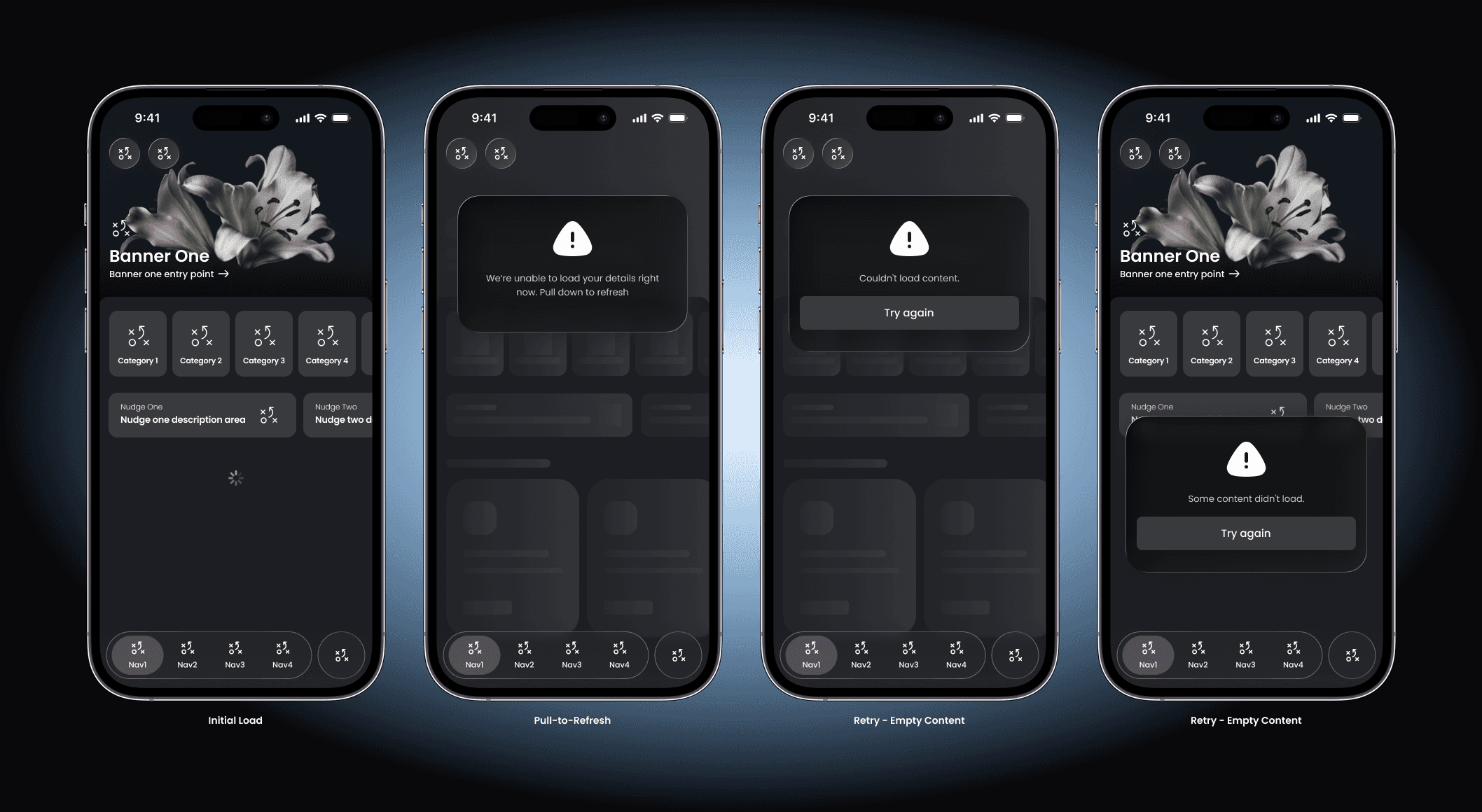
Loading States Interactions is a UI and motion exploration focused on how digital products communicate system activity while content is loading, refreshing, transitioning, or temporarily unavailable. The project explores multiple loading scenarios and interaction patterns, using motion, hierarchy, progressive disclosure, and reusable components to make waiting states feel intentional rather than disruptive.
Context
Product Context
A systematic exploration of loading and transitional states across mobile product experiences.
Audience
Users interacting with digital products where content, data, or actions require time to load or update.
Problem Being Solved
Loading states are often treated as temporary placeholders rather than part of the product experience. Poorly designed states can create uncertainty, make interfaces feel slower, and leave users unsure whether the system is working. The challenge was to design loading experiences that provide clear feedback while maintaining continuity and visual stability.
Design Challenge
Communicating system activity without overwhelming the user
Designing different loading behaviors for different content scenarios
Maintaining context while content progressively becomes available
Creating meaningful transitions between loading and loaded states
Avoiding repetitive or purely decorative loading animations
Building patterns that can scale across different product experiences
UX Strategy
1 – Contextual Loading
Designing loading states based on the type and amount of content being requested
Maintaining existing content where possible instead of replacing the entire interface
Using progressive loading to preserve user context
Differentiating between initial loading, refresh, and partial-content states
2 – Motion as Feedback
Using animation to communicate that the system is actively working
Creating transitions that connect loading states with their final content
Establishing consistent timing and movement principles
Reducing perceived waiting time through responsive visual feedback
3 – Progressive Content
Exploring skeleton states for structured content
Supporting partial and incremental content loading
Designing transitions between placeholder and final UI
Maintaining layout stability as new content becomes available
4 – State-Based Interaction
Mapping different system states and their relationships
Designing patterns for loading, refresh, empty, retry, and partial-content scenarios
Creating clear visual distinctions between system states
Establishing reusable interaction patterns across components
Interaction Architecture
The system explores loading as a connected experience rather than a single animation.
Loading → Content → Refresh → Partial State → Complete State
Each state has its own visual and interaction behavior while remaining part of the same overall system.
System Thinking
Reusable loading components and interaction patterns
Consistent grid and spacing principles
Structured state hierarchy across different content types
Motion behaviors that can be applied across multiple components
Scalable patterns for future product experiences
Motion Principles
Motion should communicate system status
Transitions should preserve spatial relationships
Animation should feel responsive rather than distracting
Loading behavior should reflect the context of the content
State changes should be clear even without additional explanation
Interactive Animation
The project includes interactive animation explorations demonstrating how loading components transition between different states.
These experiments focus on timing, easing, hierarchy, content replacement, and the relationship between motion and interface feedback.
Outcome
Created a structured framework for designing loading and transitional states
Explored multiple loading scenarios across different content contexts
Developed reusable interaction and motion patterns
Established clearer relationships between system states
Demonstrated how motion can reduce uncertainty and improve perceived responsiveness
Scope of Work