Users don’t leave suddenly. They drift.
Most products don’t lose users overnight.
They lose them gradually.
First, users engage less.
Then they skip sessions.
Then they forget the product exists.
By the time teams notice, the user is already gone.
This isn’t a retention problem.
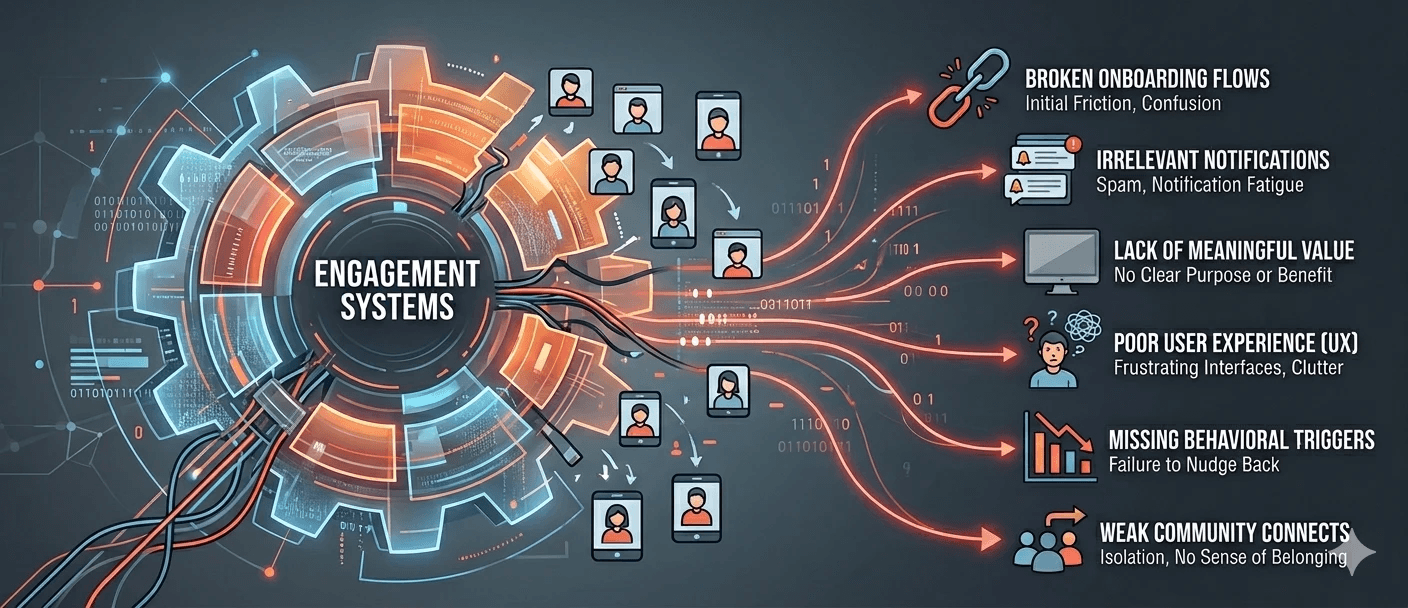
It’s an engagement system failure.
Engagement is not about features
When retention drops, teams react predictably:
add notifications
introduce rewards
redesign UI
push promotions
These tactics create short-term spikes.
But spikes are not engagement.
Engagement is sustained interaction over time.
The difference between usage and engagement
A user opening your product is not engagement.
A user completing meaningful actions repeatedly is.
Real engagement requires:
clear value
repeated benefit
behavioral reinforcement
Without these, usage becomes accidental, not intentional.
Engagement systems are built on loops
Nir Eyal’s Hook Model describes engagement as a loop:
Trigger → Action → Reward → Investment
But many products break this loop.
Common failures:
triggers without value
actions with friction
rewards that feel empty
no reason to return
When any part weakens, the loop collapses.
The role of meaningful rewards
Not all rewards drive engagement.
There’s a difference between:
superficial rewards (badges, points)
meaningful rewards (progress, mastery, outcome)
Users return when they feel:
progress
improvement
control
If the reward doesn’t matter, the loop dies.
Friction kills loops silently
Even small friction can break engagement:
too many steps
unclear next action
slow performance
confusing navigation
Users don’t complain.
They just stop.
BJ Fogg’s model reminds us:
If something is hard to do, it won’t be done repeatedly.
The importance of momentum
Engagement is not about one good experience.
It’s about continuity.
Products that sustain engagement create:
clear next steps
visible progress
predictable outcomes
habit-friendly interactions
Momentum reduces decision-making.
Users don’t think.
They continue.
Designing for return, not just use
The key question is not:
“Why would users use this?”
It is:
“Why would users come back tomorrow?”
This shift changes:
feature design
onboarding
notifications
product flow
Return behavior is the real metric.
Takeaway
Users don’t stop coming back because they lose interest.
They stop because the product fails to sustain meaningful engagement loops.
Strong products don’t rely on attention.
They build systems that earn return.
If your product doesn’t give users a reason to come back, they won’t.