Great ideas rarely fail. Poor strategy does.
Startup history is full of products built around exciting ideas that never reach traction.
The issue is rarely creativity.
It is the absence of a strategic bridge between an idea and the market.
Teams often jump directly from:
Idea → Building
But the real journey is:
Idea → Problem clarity → Value proposition → Product → Market fit
Skipping the middle creates what many product teams experience as the strategy gap.
Product ideas are cheap. Problem clarity is rare.
Many founders and product teams start with solutions.
A new feature.
A new platform.
A new AI capability.
But successful products start with a clearly defined problem space.
Product strategist Marty Cagan emphasizes in Inspired that great products begin with deep understanding of:
user needs
business viability
technical feasibility
Without this foundation, teams build solutions searching for problems.
Product-market fit is a strategic outcome
Marc Andreessen famously described product-market fit as the moment when a product satisfies strong market demand.
But this moment rarely appears accidentally.
It emerges when teams align three elements:
Real user problems
Clear value propositions
Focused product scope
Many products fail because they attempt to solve too many problems at once.
Strategy requires constraint.
The role of product strategy frameworks
Frameworks help teams structure thinking before committing to execution.
Some commonly used approaches include:
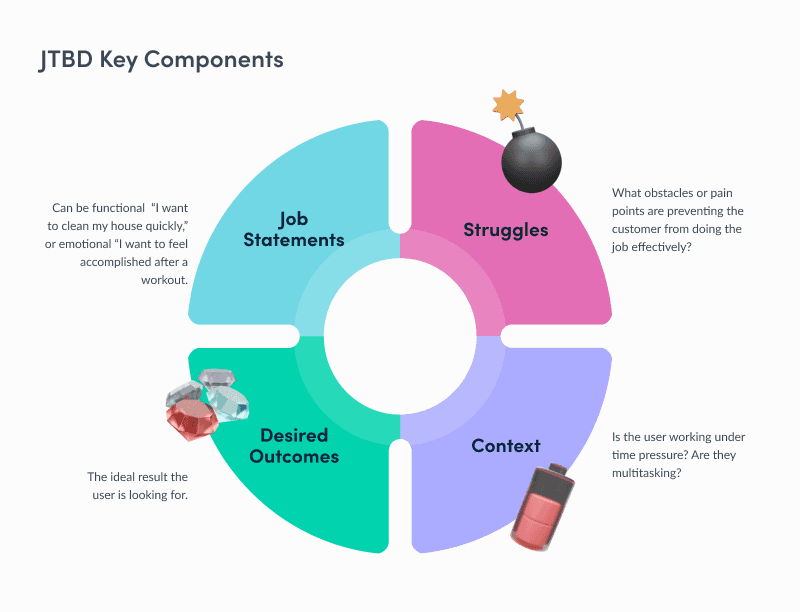
Jobs to Be Done (Clayton Christensen)
Lean Startup validation loops (Eric Ries)
Opportunity solution trees (Teresa Torres)
These frameworks force teams to answer critical questions early:
What progress is the user trying to make?
What outcome defines success?
What assumptions need validation?
Strategy reduces uncertainty before development begins.
Why execution cannot replace strategy
Teams often believe that shipping faster will eventually lead to traction.
Speed helps, but it cannot compensate for misalignment.
Fast execution without strategic clarity simply accelerates failure.
Effective product teams invest time in:
problem discovery
user research
value proposition testing
prioritization discipline
Execution should scale strategy, not replace it.
Strategy creates focus
Strong product strategy answers three fundamental questions:
Who is the product for?
What problem does it solve better than alternatives?
Why does it matter now?
Clear answers guide roadmap decisions and prevent feature sprawl.
Without strategic focus, products gradually become collections of disconnected features.
Takeaway
Product ideas spark innovation, but strategy determines whether that innovation reaches real users.
The gap between ideas and product-market fit is not filled by development effort alone.
It is filled by deliberate product strategy that connects user problems, value creation, and market demand.