Users don’t behave the way they say they will
One of the most common frustrations in product design:
Users say they will use a feature…
then they don’t.
They say they want simplicity…
then ignore simple solutions.
They say they value privacy…
then click “accept all.”
This isn’t irrational behavior.
It’s human behavior.
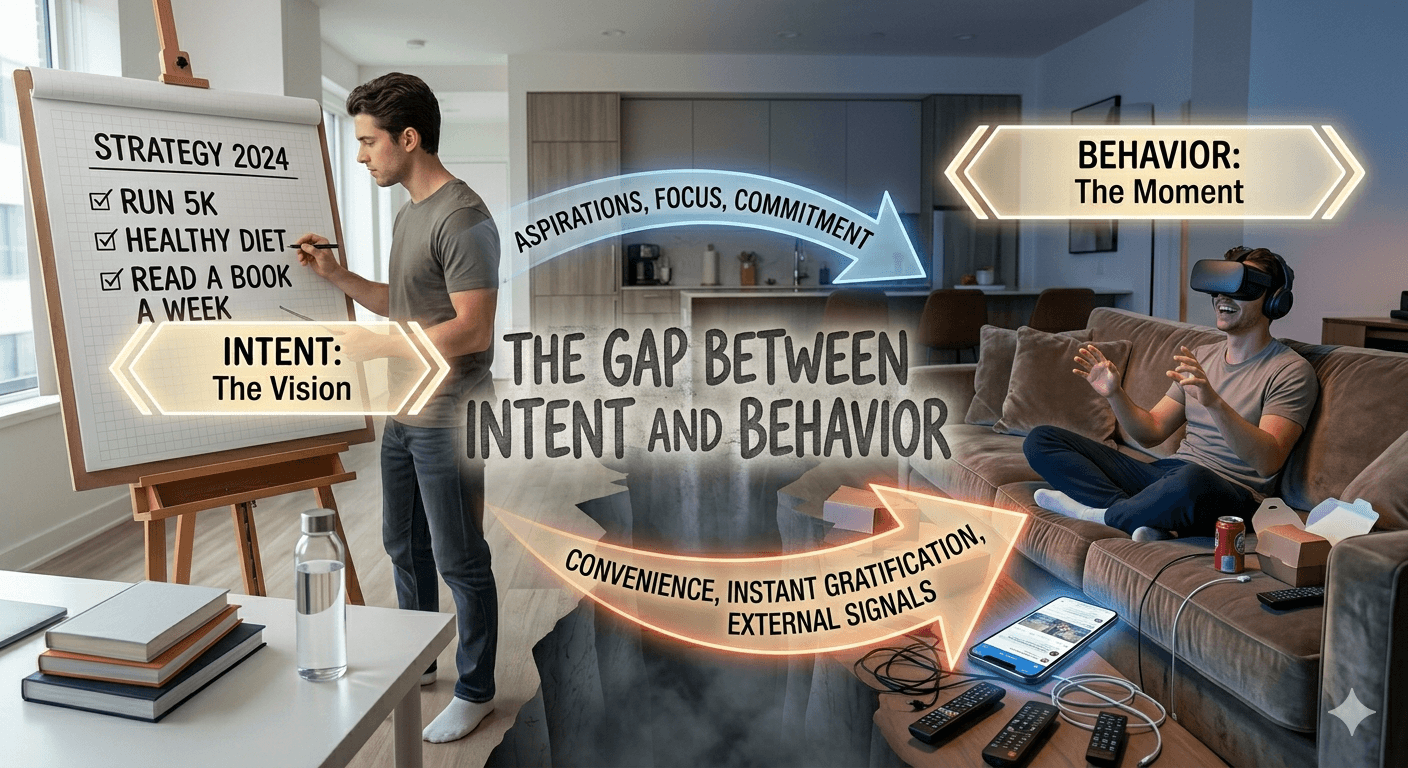
The intention–behavior gap
Behavioral science describes a consistent gap between what people intend to do and what they actually do.
Daniel Kahneman’s Thinking, Fast and Slow explains why.
Humans operate in two modes:
System 1 → fast, automatic, intuitive
System 2 → slow, deliberate, rational
Most product interactions happen in System 1, not System 2.
So even if users intend something rationally, their actions are driven by speed, habit, and context.
Friction shapes behavior more than motivation
Product teams often try to change behavior by increasing motivation.
Better messaging.
Better features.
More value.
But BJ Fogg’s Behavior Model shows that behavior is a function of:
Behavior = Motivation + Ability + Trigger
If something is hard to do, motivation won’t save it.
Lowering friction is often more effective than increasing desire.
The power of defaults
Defaults are one of the strongest behavioral tools in product design.
Users tend to:
accept pre-selected options
avoid extra effort
follow the path of least resistance
This is known as the default effect.
Examples:
subscription auto-renewals
pre-selected privacy settings
recommended choices
Small design decisions shape large outcomes.
Context beats intention
Behavior doesn’t happen in isolation.
It happens in context.
Time pressure, distractions, device constraints, and emotional state all influence decisions.
A user might intend to:
read carefully
compare options
make thoughtful choices
But in reality:
they’re multitasking
they’re tired
they’re rushing
Design that ignores context will always feel “mysteriously ineffective.”
Designing for real behavior
To design effective products, shift from:
“What do users want?”
to
“What will users actually do in this moment?”
This means:
reducing steps
simplifying decisions
guiding attention
making actions obvious
Good behavioral design doesn’t rely on effort.
It works with human tendencies.
Ethical responsibility
Behavior design is powerful.
It can:
guide
influence
shape decisions
This raises ethical questions.
Richard Thaler’s concept of “nudging” emphasizes that influence should:
preserve user autonomy
be transparent
avoid manipulation
Design should support users, not exploit them.
Takeaway
Users don’t behave based on intention alone.
They act based on friction, context, and cognitive shortcuts.
Understanding this gap is what transforms design from interface creation into behavior shaping.
If you design for what users say, you’ll be disappointed.
If you design for what they actually do, you’ll be effective.