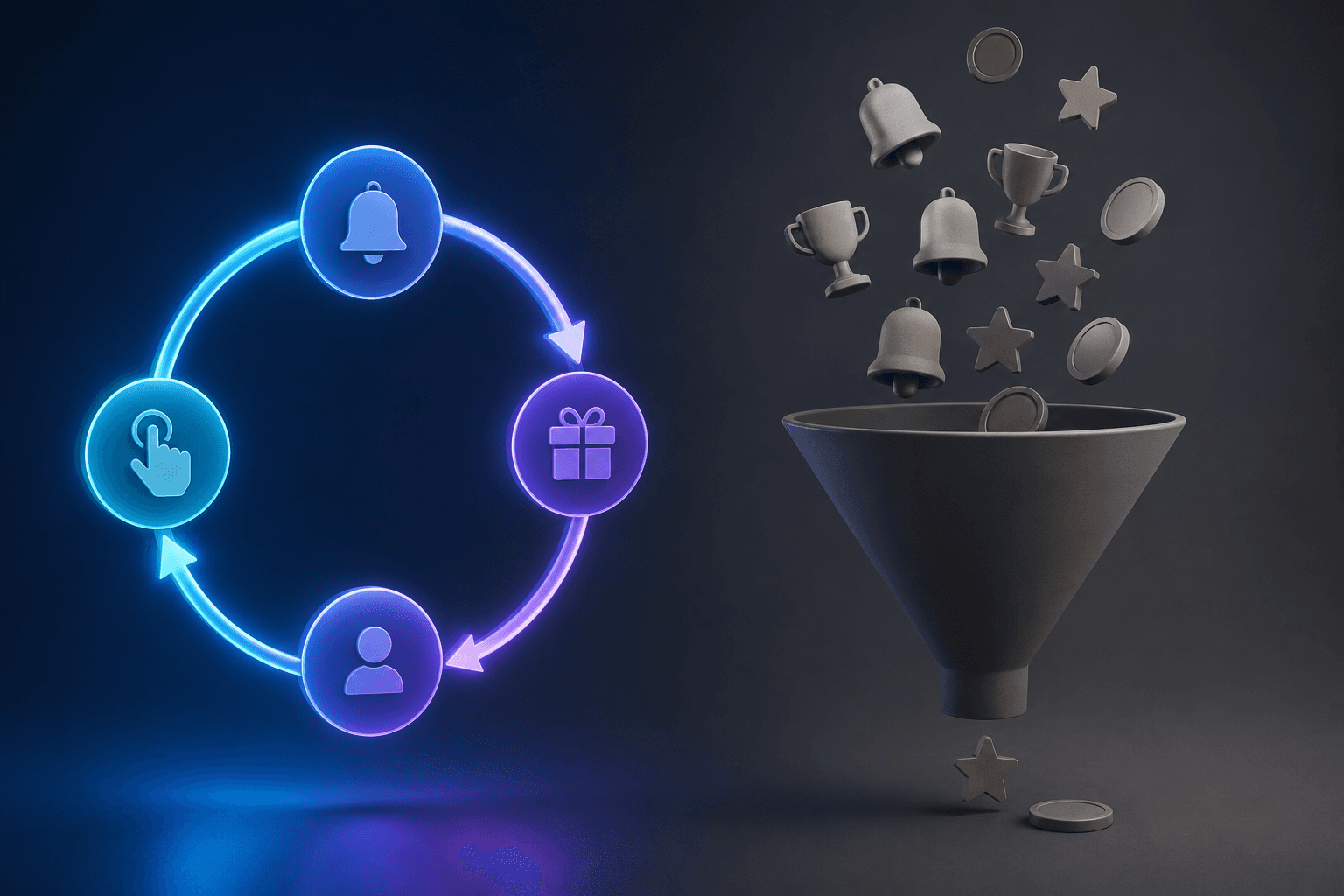
Retention isn't the same as engagement
When teams want to improve retention, they often add:
notifications
badges
streaks
rewards
reminders
These can create short-term activity.
But activity isn't the same as retention.
A notification can bring someone back once.
A well-designed engagement loop gives them a reason to return repeatedly.
What is an engagement loop?
An engagement loop connects a user's action to a meaningful outcome that encourages another action.
Nir Eyal's Hook Model, introduced in Hooked, describes a cycle involving:
Trigger → Action → Reward → Investment
The important part isn't the framework itself.
It's the momentum between interactions.
A user does something valuable, receives an outcome, and has a reason to continue.
Features create moments. Loops create momentum.
Consider a fitness product.
A notification saying:
"Don't forget your workout."
is a retention feature.
But a system where the user:
sets a goal → completes a workout → sees progress → builds a streak → adjusts the goal
creates a loop.
The difference is important.
The first asks the user to return.
The second gives the user a reason to return.
Look at products people return to
Products such as Duolingo and Strava embed engagement into their core experiences.
Duolingo connects:
learning → progress → rewards → streaks → another session
Strava connects:
activity → performance feedback → progress → social recognition → another activity
The loop isn't something added on top of the product.
The loop is part of the product experience.
Design the investment
The final part of Eyal's Hook Model is particularly interesting: investment.
Investment means the user's previous action creates value for future interactions.
This could be:
saved preferences
progress
personal data
completed history
social connections
accumulated achievements
personalized recommendations
The more meaningful the investment, the more useful the next interaction can become.
This creates a feedback loop between past behavior and future value.
Don't manufacture engagement
Not every product needs streaks.
Not every experience needs gamification.
And not every notification deserves to exist.
The goal is not to maximize time spent in the product.
It's to create repeated value.
This distinction matters because engagement tactics can become manipulative when they optimize behavior without improving the user's outcome.
Good Engagement Design asks:
"What value makes the user want to come back?"
Not:
"How can we make them come back?"
From retention features to engagement systems
A useful way to evaluate a retention idea is to ask:
Does it create a one-time action?
Or:
Does it strengthen the product's core value loop?
A notification might remind someone to exercise.
A progress system can make their fitness journey visible.
A badge might reward an action.
A meaningful achievement can show progress toward a goal.
The difference is value versus interruption.
Takeaway
Retention features can create moments of activity.
Engagement loops create reasons to return.
The strongest products don't simply remind users to come back.
They create a cycle where:
Action → Value → Progress → Investment → Return
The goal of Engagement Design isn't to keep users busy.
It's to make returning valuable.