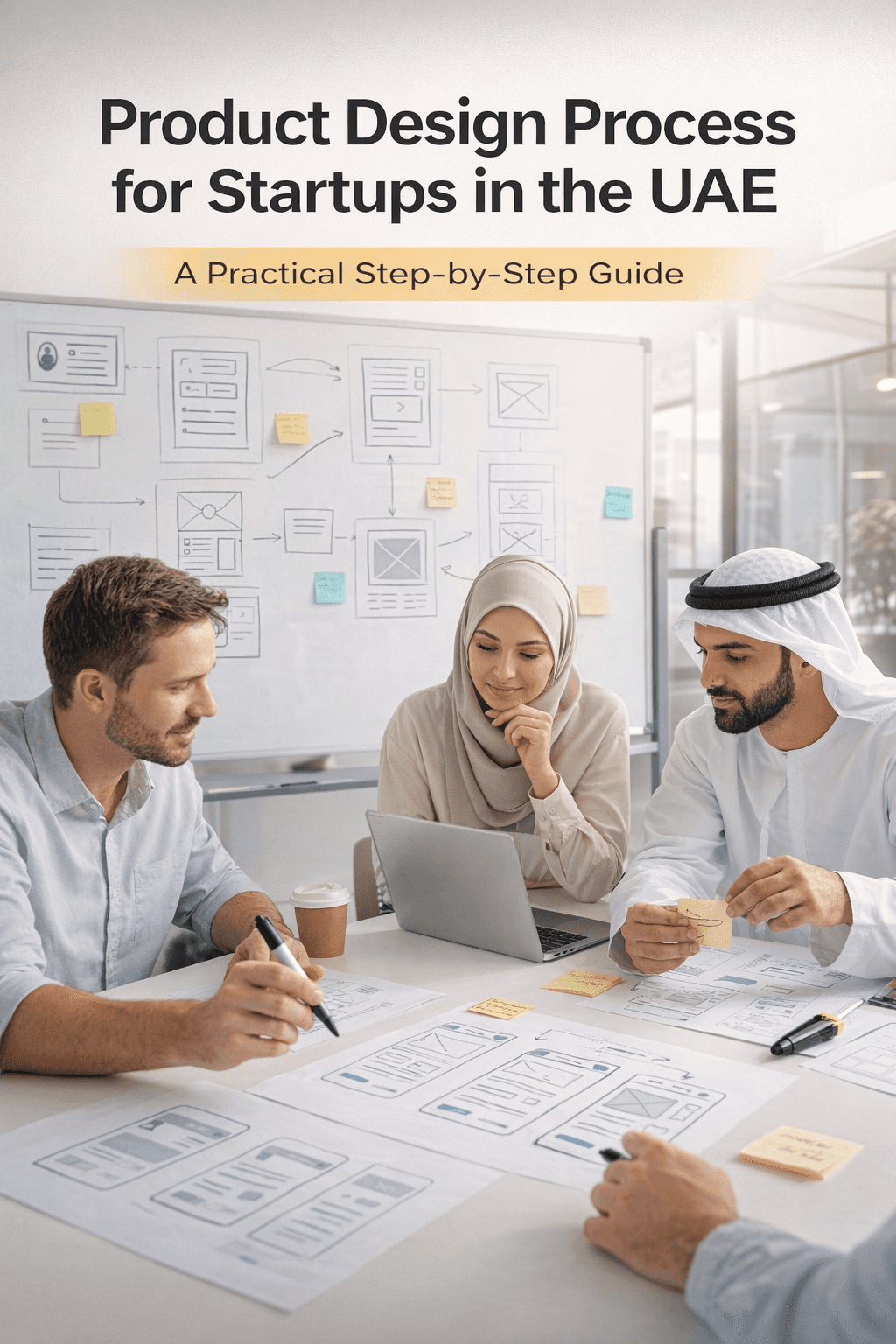
Why Product Design Looks Different in the UAE
Building digital products in the UAE is not the same as building them in Silicon Valley or Europe.
Startups in this region operate across diverse user behaviors, multilingual audiences, regulatory requirements, and fast-moving business environments. Applying a generic product design process without adapting it to this context often leads to wasted effort, unclear priorities, and products that struggle to gain adoption.
This article breaks down a practical product design process for startups in the UAE and MENA, grounded in real constraints rather than idealized frameworks.
1. Start With Business Reality, Not Screens
One of the most common mistakes startups make is jumping straight into UI design.
Before opening Figma or sketching interfaces, teams need alignment on:
Business goals
Market maturity
Team size and capabilities
Time-to-market expectations
Product leaders like Marty Cagan, author of Inspired, consistently emphasize that successful products start with understanding why they are being built, not just what they look like.
In the UAE, this step is especially important because startups often balance:
Speed versus compliance
Local validation versus regional scale
MVP delivery versus investor expectations
Design without business context is decoration, not product work.
2. Understand Users in the UAE and MENA Context
User research in MENA markets is often skipped or oversimplified.
A common assumption is that users in the region behave the same way as users elsewhere. In practice, this is rarely true.
Typical patterns include:
Frequent language switching
Strong reliance on trust signals
Mobile-first behavior across most demographics
Design thinkers like Don Norman, author of The Design of Everyday Things, highlight that good design adapts to real human behavior rather than abstract personas.
For startups in the UAE, lightweight but focused research works best:
Short user interviews instead of long surveys
Observational insights instead of assumptions
Cultural awareness instead of imported UX patterns
3. Define the MVP With UX in Mind
An MVP is not a smaller version of the final product.
It is a learning tool.
Product discovery experts such as Teresa Torres, author of Continuous Discovery Habits, advocate validating assumptions early and continuously rather than after full development.
For startups in the UAE and MENA, this usually means:
Aggressively reducing feature scope
Designing for clarity over visual polish
Prioritizing usability over branding expression
A focused MVP answers one key question well instead of many questions poorly.
4. Introduce a Design System Early (Even a Small One)
Design systems are often associated with large companies like Google or Shopify, but startups benefit from them even more.
An early design system does not need to be complex. A small, intentional system helps teams:
Maintain consistency
Reduce design and development friction
Scale faster without rework
Frameworks such as Atomic Design by Brad Frost explain how simple component-based thinking can grow naturally with the product.
5. Validate Before You Ship
In fast-moving startup environments, validation does not require formal usability labs.
Effective validation methods include:
Clickable prototypes
Internal testing with non-designers
Short feedback loops with real users
Design sprint methodologies popularized by Jake Knapp, author of Sprint, show how teams can reduce risk quickly before committing engineering effort.
In the UAE market, speed matters, but validated speed matters more.
6. Ship, Measure, and Iterate
Shipping a product is not the end of the design process.
It is the beginning of real learning.
High-performing teams, including those at regional companies like Careem and Noon, iterate continuously based on:
User behavior
Conversion data
Customer support feedback
A strong product design process creates space for iteration, not perfection.
Recommended Resources
For teams looking to go deeper into product design and strategy, the following resources are worth exploring:
These resources focus on fundamentals rather than trends, making them relevant long-term.
Final Thoughts
A solid product design process helps startups in the UAE and MENA:
Reduce risk
Move faster with clarity
Build products users actually adopt
Design is not decoration.
It is decision-making.
And in competitive markets like the UAE, better decisions are often the difference between products that launch and products that last.